Return to flip book view
1
§Project Info85 minutes English languageGothic tragicomedy with supernatural themes2
§Project Info85 minutes English languageGothic tragicomedy with supernatural themes3
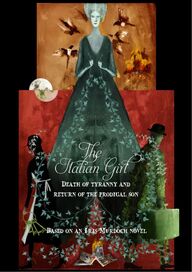
IntroThe Italian Girl is a gothic tragicomedy about a dysfunctional family ghting over the spoils of their deceased mother. It is a mesmerising and witty drama, full of surreal twists and shocks. Our script is based on the book by one of the best novelists of the 20th century, Booker-winning author Iris Murdoch.4
5
The tyrannical matriarch Lydia is dead, and her will is missing. As the household ghts for a share of the spoils, Lydia’s ire has been awoken, and her malevolence will return.Logline6
It’s 1964, and a gothic rectory on an isolated bay is home to the Narraways. Estranged son Edmund has returned for the funeral of his tyrannical mother Lydia, still carrying the burden of the past. He plans to return on the rst train, after getting his share of the inheritance. The next day, the family gathers for the funeral: Edmund’s hapless stonemason brother Otto; his caged sister-in-law Isabel; her teenage daughter Flora; Otto’s apprentice and provocateur David Levkin; Maggie Magistretti — the Italian Girl, the family servant, babysitter, seamstress, cook, and the matriarch’s silent lover. Edmund resents all of them and their messy lives. But the will is nowhere to be found, and little by little, over seven days, a series of events postpone Edmund’s return, as he is begrudgingly drawn into family secrets and revelations. Isabel is desperate to escape the house and her loveless relationships, imploring Edmund to take her away; teenage Flora is pregnant and pleads with Edmund to help with her illegal abortion; alcoholic Otto is having a reckless aair with Elsa, David’s sister and is desperate for his brother to stay and sort them all out. The conniving and omnipresent David is meanwhile manipulating and seducing everyone, steering the household to inevitable destruction. Elsa, the lm’s innocent prophetess, through her tarot card readings, reveals a haunted past. Six women, accused of being witches, were burned at the stake where the house stands now, passing on their powers to Lydia and her devoted disciples, the Italian Girls. Maggie, the last and 6th Italian Girl, is initially silent, holding her secrets till her dramatic transformation and the explosive nale. Synopsis7
Writer & Producer Tatevik AyvazyanEmotions & Pistol ShotsDirector & Writer Garo Berberian 8
While it’s a period piece, its narrative strands about women’s rights, abortions, homophobia, immigrants, as well as the elements we added — tarot cards, dream sequences, supernatural twists — are some of the things we focus on that are relevant to today’s audience. Edmund, the unreliable narrator, gives us at times funny, at times dark insights into his thoughts and memories, still wounded by the electroshock ‘therapy’, administered to ‘cure’ his homosexuality. While he’s the protagonist, The Italian Girl is a story of women, who, while seemingly free, are oppressed in dierent ways—whether it’s because of their economic status, lack of education, sexuality, unwanted pregnancy, or simply because they’re a foreigner. But they all know what they desire, whether it’s freedom, money, or, as one of the characters puts it, emotions and pistol shots. The Italian Girl had more than 70 editions since 1964The Italian Girl has been on Tatevik’s top list for years as a great novel to adapt into a lm because of its unique blend of black comedy, gothic horror, period piece and a family drama, sprinkled with Shakespearean and Greek tragedy elements. 9
Stanley Spencer, Fire Alight (1936)Art is used as a visual metaphor throughout the film, a backdrop during the interplay between our characters. 10
Visually, every character inhabits their particular space, each with a distinct colour palette that changes according to the time of day and emotion. Dream sequences and ashbacks add another strand to the lm. Edmund’s dark dreams echo the memories of his traumas, while Otto is also traumatised by their mum, but in contrast, his dreams are comical metaphors. Elsa’s ashbacks are also an important part of explaining her and her brother’s past, escaping the USSR in a hope of a better future in the West. The script’s twisted plot, vivid visual language, and inimitable characters make a fascinating and entertaining story. 11
Edmund gives us a vision of backstories and subplots and is a constant throughout all the scenes, and the other six characters appear as an ensemble cast. Their story arcs are serpentine and develop over the seven-day timeline. We establish the feeling of certainty about an individual, how they behave and are perceived, but soon leave the audience with the uneasy feeling that nothing is quite what it seems, a theme we take through to the end. Tarot cards created by Elsa Levkin were added to the screenplay by us, not only as an element of the supernatural, but also as a way of forcing our initial perceptions about each of the characters to be challenged as we put them in a dierent light.Characters12
13
Edmund Narraway32 years old, 6’0’’ tall and slim, good-looking, uptight, careful, looking more like an accountant than an engraver. He’s the narrator, full of doubts, judgment, and trauma, some of which are heard in his voiceovers and seen in his dreams and ashbacks. Otto Narraway(Edmund’s brother) 34 years old, 6’3’’ tall, with red hair and blue eyes; a broad man with exceptional physical strength. An alcoholic, a philosopher, and a womaniser, he is sometimes a comedy character, but he leads an unfullled existence, failed as an artist, husband, son, and father. 14
Otto Narraway(Edmund’s brother) 34 years old, 6’3’’ tall, with red hair and blue eyes; a broad man with exceptional physical strength. An alcoholic, a philosopher, and a womaniser, he is sometimes a comedy character, but he leads an unfullled existence, failed as an artist, husband, son, and father. Lydia Narraway (Edmund’s and Otto’s mother)Died at 60, petite, with grey hair that used to be copper, cobalt blue eyes. Even after her death, Lydia remains a central character in the lm. Her diminutive appearance belies the true nature of Lydia’s power, control, and fear she instils in the household. She is very much alive in Edmund’s and Otto’s dreams and Elsa’s tarot readings, and is responsible for the story’s nal twist. Characters15
Flora Narraway(Otto’s daughter)16 years old, a redhead with green eyes. Young, arty, explosive and impulsive, she lives in the swinging 1960s, starkly contrasting the rest of the household. She is abandoned by everyone in the house, but goes through an illegal abortion on her own. Despite this ordeal and family drama, she grows up in 8 days and in a Shakespearean twist, sticks by her father. 16
CharactersDavid Levkin (Otto’s apprentice)26 years old, with blond hair and brown eyes,the provocateur, the gambler, the player, and the joker. Handsome and charming, athletic and well-dressed, David attracts attention: Otto is impressed, Edmund—bitter and sexually conicted, Isabel–besotted, Maggie–suspicious, and Flora is mesmerised. He calls himself a Lion, roaming the grounds of the Narraway house and playing with re. Isabel Narraway(Otto’s wife)32 years old, with thick auburn hair and chestnut eyes. A Femme Fatal, victim, seductress — all these apply to Isabel. Isolated from everyone, Isabel had created her little world —a lush boudoir, a provocation against Lydia’s Spartan rules. Dressed in beautifully designed outts, she has nowhere to go, caged and bored. Once she dares to claim freedom, she is richly rewarded with whatever she wants. 17
John Narraway (Edmund’s and Otto’s father)Tall, with light brown wavy hair and brown eyes, Otto’s and Edmund’s talented father is now dead, but his presence and memories are in the house through his art and an impressive collection of paintings from his contemporaries, including a much-contested Stanley Spencer. 18
CharactersElsa Levkin (David’s sister)25 years old, athletic with metallic hair and graphite-coloured eyes. An immigrant from the USSR, she is stuck in the strange world of the Narraway family because of her brother. She’s the innocent who doesn’t belong to any place, and is most likely to be found in the garden, observing everyone with her Polaroid camera. She has a talent for Tarot readings and prophecies, but is not heard, just like Cassandra. Maggie Magistretti (the housemaid)39 years old, slightly built, with raven black hair and amber eyes. As the maid of the house, she’s always silent, wears only black and is omnipresent, aware of everything. She goes through a dramatic transformation after Lydia’s will is discovered, and angry Flora chops o her ponytail — and is metamorphosed both visually — into a modern, very attractive woman in a bright red dress. 19
20
Iris Murdoch is one of the best British writers of the 20th century, a fabulous, exciting novelist, who has been nominated for the Booker Prize seven times, winning it for her The Sea, The Sea. In 2023, the Booker Prize statuette was named Iris, after her. She’s much loved in Ireland too, with her 100th anniversary recently cele-brated with a release of postage stamps. 21
The Old Rectory22
EDMUNDIt has been foolish, entirely fool-ish, to come. To come now that she was dead, was a mere self-punishment. But after all she was my mother.ACT 11 EXT. OVERGROWN FRONT GARDEN - NIGHT23
The Hallway24
There is a huge TIGRESS reclining at the base of the staircase, under the shadow of Lydia’s portrait. She is scouring the hallway, guarding her mistress’ domain.12 INT. HALLWAY - NIGHT – OTTO’S DREAM SEQUENCE25
EDMUND I had never really left Lydia. Lydia had got inside me, into the depths of my being, there was no abyss and no darkness where she was not. She was my self-contempt.ACT 1 5 INT. LYDIA’S BEDROOM - CONTINUOUS26
Lydia’s Bedroom27
Isabel’s Room28
ISABEL Perhaps you’re right. You’d better get back to your good life. I shouldn’t have bothered you like this. It’s just that I’m caged, bored.I want emotion and pistol shots.ACT 211 INT. ISABEL’S ROOM - DAYIsabel’s Room29
The Kitchen30
Flora grabs hold of Maggie’s hair with one hand and the scissors with the other, flourishing them like a knife. She shears her braid at the nape of the neck. With an exclamation of horror and disgust, Flora drops the oblong knob of hair on to the table where it unravels into a black snake.There is silence.34 INT. KITCHEN - EVENINGThe Kitchen31
Otto then picks out a small wooden box containing erotic photographs, dramatic and theatrical in suggestive positions. He then playfully thrusts a picture of a naked couple in Edmund’s face, who reels back, with a painful flashback of electroshock therapy.ACT 229 INT. WORKSHOP - DAYOtto’s Workshop32
Otto’s Workshop33
Artwork34
35
36
Dream Sequences37
Garo Berberian Writer and DirectorTatevik Ayvazyan Writer and Producer Contact: tatevik@rebelrepublicfilms.com - +44 7909 966266Team / Contact 38
Tatevik Ayvazyan Writer and Producer Noosh B ProducerContact: tatevik@rebelrepublicfilms.com - +44 7909 966266Team / Contact 39