
CAROLLO ENGINEERS VOLUME 1 2026
No Challenge
Too Great for San Francisco’s
Award-Winning Headworks
PLUS
Process Intensification to
Optimize Performance
Bridging the Infrastructure Gap
for Small Communities
New Digital Tools Transform
Master Planning
Making an Impact in Malawi, Africa

CURRENTS / IN THIS ISSUE
EDITORIAL
CONTENT EDITOR
Diana Leonard / dmleonard@carollo.com
COPY EDITOR
Mary Ann Mavrogianes
GRAPHIC DESIGNER
Silvia Higuera-Backlund
Cover photo by Ethan Kaplan Photography
DIANA LEONARD (dmleonard@carollo.com)
This issue’s feature story takes an
in-depth look at the challenges met
during design and construction of San
Francisco’s newest headworks facility—
demonstrating how innovation and
collaborative problem-solving overcame
a variety of challenges and delivered a state-of-the-art,
award-winning project.
We also explore the latest process intensification strategies
and how they’re helping optimize treatment at many
facilities, and we detail how a national program is helping
small communities struggling with aging or failing water
and wastewater infrastructure develop and fund cost-
effective solutions.
In our article about digital master planning tools, we look
at how new technology is transforming static documents
into dynamic management tools capable of addressing
new challenges long after the planning process is complete.
We also take you to Malawi, Africa, where Water For People
is working with local communities to enable access to safe,
sustainable drinking water, sanitation, and hygiene facilities.
working with local communities to enable access to safe,
sustainable drinking water, sanitation, and hygiene facilities.
From new technologies to community solutions, we hope
you enjoy this issue. Please reach out to me or our authors
with your thoughts. We’d love to hear from you!
IN THIS ISSUE
Process Intensification to Optimize Performance
Bridging the Infrastructure Gap for Small Communities
The Art of Innovation: No Challenge Too Great for
San Francisco's Award-Winning Headworks Facility
New Digital Tools Transform Master Planning
Making an Impact in Malawi, Africa
2
4
6
8
10
2
PROCESS
INTENSIFICATION
Strategies for Better,
Faster, and More
Affordable Performance
ANDRE GHARAGOZIAN, PE (agharagozian@carollo.com)
YI CAO, PhD
More stringent effluent requirements, the need to expand
capacity, or the desire to reduce power and O&M costs are
driving utilities to consider wastewater process intensification
strategies. Intensification can optimize process performance
by increasing capacity, improving effluent quality, and
providing more cost-effective upgrades and greater
operational control—all within a smaller footprint.
Successfully implementing these emerging technologies
requires a risk-mitigation-based design approach that
carefully integrates new systems into existing plants while
managing technical, operational, and financial uncertainties.
Carollo's Emerging Technology Design Integration Team
(ETDIT) uses this approach and incorporates lessons learned
from operating facilities to integrate new technologies into
existing plants.
Process intensification encompasses numerous technologies at
varying stages of maturity based on factors like number of installations,
years in service, and complexity. The technologies labeled here
and discussed in this article range from emerging innovations to
established systems, each with different risk-reward profiles.
Intensification Technology Maturity Curve
Lab
Study
First
Demo
1st
Generation
2nd
Generation
3rd
Generation
Mature
Technology
Number of Installations
Pilot
Activated Sludge (AS)
Membrane Bioreactors (MBRs)
Anammox Sidestream Treatment
Anaerobic Granular Sludge
(AGS, Sequencing Batch
Reactor-Nereda
®
)
Ballasted Activated Sludge
(BioActiflo
®
, BioMag
®
)
Integrated Fixed-Film
Activated Sludge (IFAS)
Membrane Aerated Bioreactors (MABRs)
Densified Activated Sludge (DAS, InDense
®
)
Innovators
Early
Adopters
Early
Majority
Established
COMMENTARY / CURRENTS
Promising Technologies
Several emerging technologies offer
the potential to enhance or intensify
activated sludge (AS) processes. In most
AS systems, the limiting factor is usually
the ability to separate solids downstream
of a reactor.
Improving Liquid/Solids
Concentrations
Densified activated sludge (DAS)
selects for heavier, better settling floc
by washing away lighter, less desirable
biomass. It can be achieved through
biological or physical selection using
cyclones or sieves. This allows operation
at higher mixed liquor suspended solids
(MLSS) concentrations, translating to
more treatment capacity.
Ballasted activated sludge (BioMag®)
uses magnetite as a ballast to increase
floc density and enhance the settling
rate of mixed liquor in an AS process.
The magnetite ballast material is
recovered to use again. Similar to
DAS, the improved settleability allows
operation at higher MLSS concentrations.
Membrane bioreactors (MBRs)
separate solids and liquids using a
membrane rather than gravity—resulting
in 100 percent solids removal and ultra
clean effluent. Eliminating gravity settling
allows higher MLSS concentrations in
the aeration basins and reduces the
process footprint.
Combining Suspended Growth
and Fixed-Fim Processes
Integrated fixed-film activated
sludge (IFAS) is a hybrid fixed-film
and suspended growth AS process.
The fixed-film media provides a
surface to grow biofilm and increases
the biomass in the aerobic zone of a
reactor. IFAS provides the most benefit
in cold temperatures. Since the biofilm
removes some of the nutrient loads, the
suspended growth AS process can be
downsized for lower loads.
Membrane aerated bioreactors
(MABRs) are a newer hybrid process.
MABRs are unique in how membranes
supply oxygen and provide a surface for
biofilm to grow, which typically removes
30 to 40 percent of the nitrogen.
Selecting for
Specialized Microbiology
Anammox sidestream treatment
selects for anaerobic ammonia
oxidizing bacteria combined with
shortcut nitrification, reducing air and
chemical requirements. Anammox
processes don't use carbon for nitrogen
removal, so they're well-suited for
plants that must meet very low limits.
While most often used for sidestream
treatment, these processes are now
beginning to see applications for
mainstream treatment.
Aerobic granular sludge (AGS) selects
for large, rapidly-settling granules
containing all microbial cultures required
for nitrification, denitrification, and
phosphorus removal. The feast-famine
conditions created in a sequencing
batch reactor configuration, as well as
selective wasting of flocculent biomass,
encourages granule formation.
3
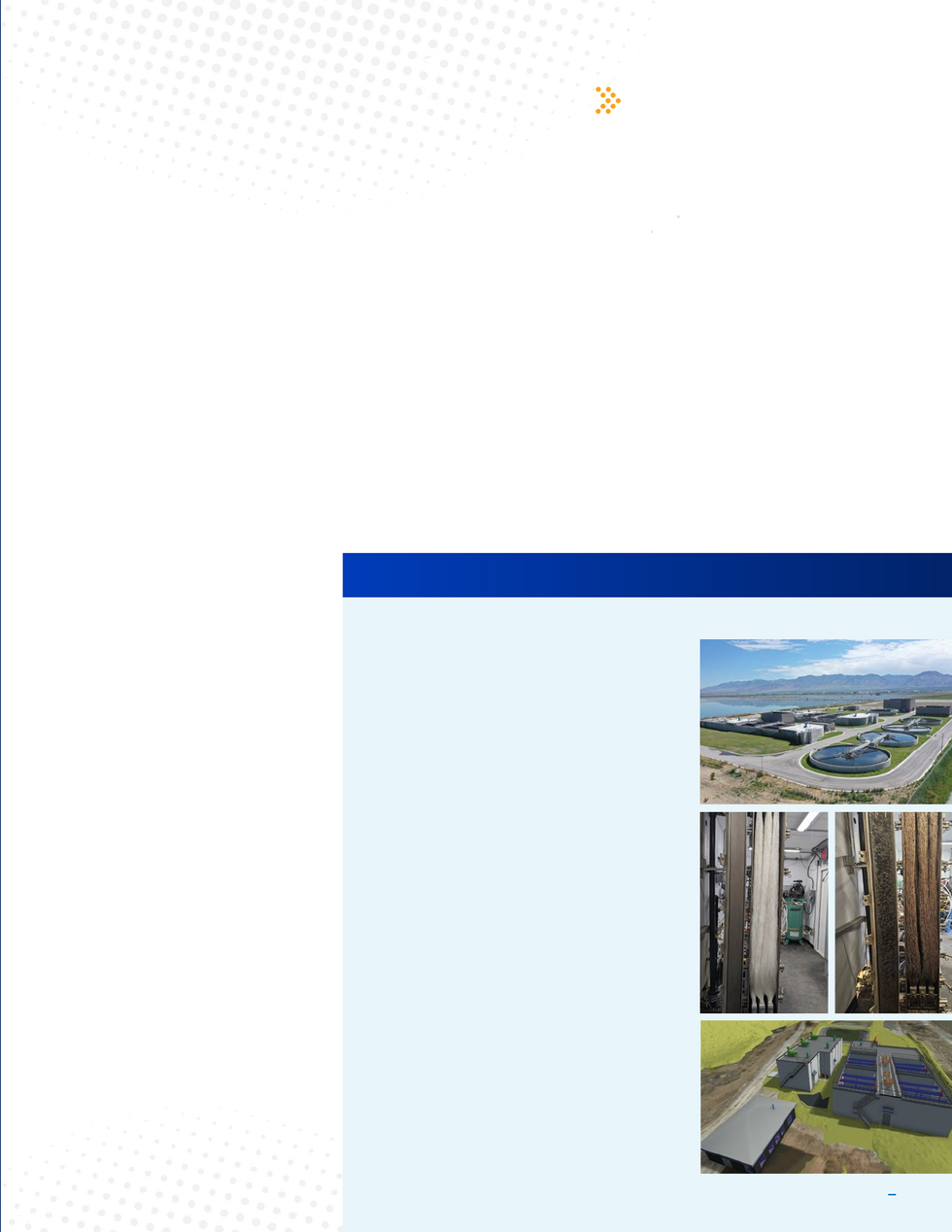
Largest Municipal BioMag
®
Facility
Logan, Utah
Carollo master planned and designed the largest
municipal ballasted AS facility in the world in Logan,
Utah. The new $135 million wastewater treatment
facility (WWTF) achieves average euent total
phosphorus and total nitrogen concentrations of
0.2 and 3.3 mg/L, respectively. Using BioMag®
instead of conventional AS reduced the size of new
aeration tanks and secondary clarifiers, saving the
city approximately $40 million in construction.
MABR Piloting
Klamath Falls, Oregon
Carollo is completing design-build delivery of
Klamath Falls’ replacement of aging facilities
and process improvements to reduce nutrient
loads to Lake Ewauna from the Spring Street
Sewage Treatment Plant. Work includes optimizing
MABR configurations with piloting and modeling
to meet stringent ammonia and phosphorus limits
in cold weather.
Nutrient Removal with AGS
Kimberley, British Columbia
The City of Kimberley is using integrated
project delivery to upgrade its WWTF. Following
technology evaluations and potential site reviews,
AGS surpassed expectations as the most feasible
and cost-eective technology to optimize nutrient
removal at the existing plant site.
Driven by growing demands for
efficiency, sustainability, and innovation,
the evolution of process intensification
relies on creative applications of novel
treatment enhancement strategies. New
developments in AI and automation
will only spur this momentum. But it's
important to remember that technology
is only half of the equation.
The value of merging science with
human creativity, resourcefulness, and a
natural drive to remain competitive in a
dynamic industry cannot be overstated.
At Carollo, our experts in process
intensification are working with several
technology providers to investigate
strategies that optimize, integrate, and
enhance these intensification methods.
We invite you to reach out to us to
discuss solutions customized to meet
your specific needs.
Tailored Solutions
Process Intensification at Work

A Coalition of Support
Some communities lack the resources and technical expertise required
for ongoing maintenance of critical public infrastructure. Recognizing this,
USEPA established a technical assistance program specifically designed
to help small, under-resourced cities and towns navigate the complex
process of infrastructure planning and funding.
Since late 2023, Carollo
has partnered with Eastern
Research Group (ERG) and
USEPA to provide technical
assistance to small, rural, or
tribal communities struggling
with aging or failing water and
wastewater facilities. What
began as a single job has
evolved to 21 active projects
across 14 states, including
California, Delaware, Florida,
Hawaii, Illinois, Kentucky, New
Mexico, New York, Nebraska,
Oregon, Texas, Washington,
Wisconsin, and Wyoming.
Successfully meeting the diverse needs of each community takes a broad
coalition of stakeholders—including a committed and passionate core
management team from Carollo and ERG, national and regional USEPA
staff, community representatives, and outside organizations offering
community assistance. Together, this partnership helps identify
water and wastewater challenges, develops feasible improvement
concepts and costs, and delivers
the Preliminary Engineering Report
(PER) documents that lay the
groundwork for state and federal
funding applications.
Stop-gap measures, such as plugging a pipe
leak with a pencil, can only do so much.
USEPA’s program helps deliver long-term,
affordable benefits to the communities that
need them the most.
While completing US Environmental Protection Agency (USEPA)-
funded water and wastewater improvements for several small
communities, Carollo has encountered the use of creative stop-gap
solutions to keep aging infrastructure operational. In one case, utility
staff actually plugged a hole in compressed air piping with a pencil.
While such repairs demonstrate resourcefulness, they also highlight
the broader challenges faced by many communities.
Scan to view the federal
requirements for producing
a typical Preliminary
Engineering Report.
ALLIE McCURDY, PE, PMP (amccurdy@carollo.com)
CARI ISHIDA, PhD, PE, ENV SP
NATE JANEGA, PE
CHAD KNIGHT, PE
BERNARDO CASTRO
44
USEPA Technical Assistance for Small Communities
CURRENTS / PROJECT UPDATE
BRIDGING THE
INFRASTRUCTURE GAP

5
As projects progress, the Carollo/ERG team works through
challenges and decision points with each community to
arrive at the most appropriate, technically and financially
feasible solution. The process sometimes dictates including
representatives from the funding organizations in project
meetings, which can help set realistic community expectations
and better prepare local participants for what can be a
daunting funding application process.
Navigating the Process
For each project, work begins with gathering information.
This entails traveling to the community, inspecting its
existing infrastructure, conferring with operations staff and
community representatives, and completing a site visit
report. The effort then turns to identifying alternatives,
vetting design concepts with all parties, developing cost
estimates, and evaluating the non-monetary ranking factors
associated with each alternative.
After presenting these alternatives and their capital and
O&M cost estimates to the group, the team incorporates
stakeholder comments and delivers the final PER.
Although some State Revolving Fund (SRF) programs require
slight variations, the format and content requirements of a
PER are set by federal guidelines established by USEPA, the
United States Department of Agriculture, the Department
of Health and Human Services, and the Department of
Housing and Urban Development. A typical PER is around
60 to 90 pages long (without appendices) and ultimately
provides a basis for funding applications for design and
construction of the preferred alternative.
Funding is Key
Because many of these communities have small rate payer
populations and want to keep costs affordable for their
customers, financial support is often needed to keep failing
or compromised systems operating. Aerated lagoons are a
common primary means of wastewater treatment. Creative
stop-gap measures—such as the pencil in the compressed
air piping or circumventing instrumentation and control so
that certain processes are operated at their highest setting
or shut off completely—are not uncommon. Plus, in certain
locales, public works expenses can exceed utility rate
revenues, pushing local governments to tap sales tax
revenue to cover losses.
In areas where water scarcity is an issue, communities
sometimes look to sophisticated wastewater processes
that allow indirect potable reuse of effluent. However, these
alternatives are frequently the most expensive. Further,
finding, retaining, and adequately compensating operators
with the required certification levels for more advanced
technologies can be difficult in remote areas.
A Proud History
USEPA’s technical assistance program has helped
hundreds of small US communities build, repair,
or replace vital infrastructure. Carollo's ongoing
commitment to this program helps guide those we
serve through complex state and federal funding
requirements and supports implementation of
affordable water and wastewater improvements
that were previously out of reach for many.
Communities Served
by Carollo/ERG
Since the Bipartisan Infrastructure Law’s inception, Carollo and
ERG have delivered technical assistance to more than 21 small
and resource-limited communities across the US.
USEPA's Bipartisan Infrastructure
Law provides funding for
technical assistance to qualifying
communities at no cost. Carollo
and ERG deliver these services
through the program.
Carollo and ERG worked with a Pacific Northwest client
to develop biosolids management alternatives, including
addressing overgrown vegetation in a sludge storage basin
that was compromising the basin liner.
Carollo and ERG worked with a Pacific Northwest client
to develop biosolids management alternatives, including
addressing overgrown vegetation in a sludge storage basin
that was compromising the basin liner.
BRIDGING THE
INFRASTRUCTURE GAP

CURRENTS / FEATURE STORYCURRENTS / FEATURE STORY
6
THE ART
6
No Challenge
Too Great for SFPUC’s
Award-Winning
Headworks
WALID KARAM, PE (wkaram@carollo.com)
MARYELLEN ESQUER, PE
JIM HAGSTROM, PE
Operated by the City of San Francisco
Public Utilities Commission (SFPUC),
the Southeast Treatment Plant
(SEP) is the city’s largest and oldest
wastewater facility, serving the
Bayside Watershed and nearly
two-thirds of San Francisco’s residents.
SEP receives and treats 80 percent
of the total annual flow from the city’s
combined sewer system.
Before the upgrade, the plant used
two headworks facilities to scale
between highly variable dry- and
wet-weather flows, allowing the plant
to treat the required 250 mgd during
rain events and discharge combined
sewer overflows (CSOs).
OF
INNOVATION
In 2015, SFPUC, Carollo, and the Sundt-Walsh Joint Venture set out to
replace SEP’s two aging headworks with a single facility that could handle
the highly variable flows and extreme grit loads unique to the plant. The
engineering challenges alone were daunting but were compounded by
massive disruptions during the 2020 COVID-19 pandemic. What emerged
was a testament to engineering innovation and collaborative problem-
solving—a sophisticated $700 million, 250-mgd facility that has set new
benchmarks for urban wastewater design and construction.
Building Up When You Can’t Build Out
The SEP headworks is boxed in by a four-lane street, active railroad tracks,
the plant’s main electrical feed, and operating treatment facilities. With
such limited space, the project team faced a fundamental design challenge:
How do you build a new, larger facility when there’s no room to expand?
The team’s answer was an innovative, vertical configuration that stacked
treatment processes instead of spreading them horizontally. This was more
than just creative architecture. It integrated screenings compaction, grit
washing, and electrical support facilities into a compact footprint. To
execute the vertical design, the team had to re-imagine how headworks
facilities could function and carefully coordinate hydraulics, structural
systems, and operational access.
The limited footprint presented another important challenge. Any new
building on the site would require removing an existing structure, and
constructing the headworks without disrupting treatment operations was
paramount. The solution was a phased “demo-to-build” approach, first
constructing a temporary 100-mgd bypass system, then demolishing the
wet weather headworks, and systematically building the new facility
without compromising treatment capacity.
The result of the team’s imaginative design and careful collaboration during
construction was a new headworks that ultimately freed up space at the
plant—an increasingly valuable commodity, as evolving regulations will
likely require new future treatment processes.
A nimble and collaborative team met the
challenges of limited space, COVID-19 supply
chain and budget disruptions, extreme grit loads,
and seismic requirements in difficult soils to deliver
a state-of-the-art headworks facility.
THE ART
INNOVATION

THE ART
INNOVATION
THE ART
INNOVATION
77
An Existential Threat
Even the most careful planning and innovative designs
weren’t immune to the massive disruptions during the
COVID-19 pandemic. In 2020, with the project already
under construction, material costs skyrocketed, supply
chains fractured, and the budget swelled $100 million
beyond projections. The team faced an existential question:
How do you dramatically reduce costs without sacrificing
quality, performance, or the project schedule?
The answer required an enormous pivot. Instead of
building a new 50-mgd influent pump station, the team
completely rehabilitated the existing structure. Though
not part of the initial scope,
this new approach kept
the project within the
original budget without
sacrificing momentum.
To stay on schedule, the
design and construction
teams worked in
lockstep—using remote
collaboration tools to
overcome pandemic
restrictions—and were
able to modify plans even
as construction continued.
When Grit Loads Defy Convention
Without effective capture and removal, grit can severely
compromise downstream equipment and processes.
But, while most water resource recovery facilities see
peak grit loads of 300 to 600 lbs/MG, because of its
location and San Francisco’s CSOs, the SEP routinely
experiences loads exceeding 6,100 lbs/MG—more than
ten times industry norms.
The team ran a year-long, full-scale, 5-mgd pilot study to
select the equipment best suited for the design. The pilot
evaluated multiple, side-by-side grit separation and washing
technologies under actual operating conditions. The results
guided selection of a system capable of handling the extreme
load requirements. It also efficiently separates organic material
from inert grit, resulting in reduced grit disposal volumes.
In another display of ingenuity, the design team used
hydraulics to optimize the screening process and raise
the hydraulic grade line under high-flow conditions. This
maintained proper screen velocities with just four screening
channels—half the number originally anticipated—saving both
space and capital costs while reliably maintaining optimal
performance under all flow conditions.
Seismic Resilience from Unstable Ground
A critical piece of infrastructure in an earthquake-prone region,
the new headworks facility had to meet rigorous seismic
standards, including the ability to withstand a 7.8 magnitude
earthquake. Designing for seismic resilience in the San
Francisco Bay Area is challenging enough, but doing so atop
“bay mud”—deep, unstable soil near a major fault line—was a
major hurdle. An inspired structural design used piers drilled
nearly 100 feet deep to provide adequate support.
The existing pump station presented an even thornier
problem. Its aging pile foundation fell far short of seismic
codes, but replacing it was too costly. The solution was to
support the existing structure using a new concrete slab
constructed atop the existing structure and supported by
17 drilled piers up to four feet in diameter and 120 feet deep.
This approach effectively “hangs” the 50-mgd pump station
from the new slab—bringing this critical facility up to code
without the cost and disruption of replacement.
A Model of Collaboration and Sustainability
Sometimes overcoming the odds isn’t about having all the
answers upfront, but rather tapping creativity and teamwork
to find solutions along the way. The SEP headworks
team maintained a collaborative partnership, even when
circumstances demanded rapid pivots, and delivered a state-
of-the-art facility within a limited urban footprint. The project
earned a Water Environment Federation (WEF) National
Project Excellence Award and an Institute for Sustainable
Infrastructure (ISI) Envision® Gold Award—the first headworks
nationally to achieve this recognition.
SFPUC’s SEP
headworks won a
prestigious WEF
National Project
Excellence Award,
and an ISI Envision®
Gold Award.
The evocative art installation outside the SEP headworks in
San Francisco’s Bayview-Hunters Point neighborhood is a
powerful testament to SFPUC’s environmental mission and
its ongoing investment in the communities it serves.

CURRENTS / EMERGING TECHNOLOGIES
NEW
DIGITAL
TOOLS
ERIC HAROLD, PE (eharold@carollo.com)
CAROLINE BURGER, PE
TIM LOPER, PE
ANDY BALDWIN
To Enhance
Infrastructure
Master Planning
A capacity tracking tool can seamlessly
monitor growth and development
without accessing the sewer model and
performing time-consuming simulations.
Historically, utility master
plans have provided project
recommendations and
expected short- and long-
term capital costs to guide
future project prioritization.
They also provide defensible
justifications for user rates and
connection fees. These efforts
often result in detailed reports
and recommendations that
remain static until revisited in
the next master plan update.
Meeting these needs requires adapting
to changing conditions and integrating
multiple data sources.
Carollo has developed several digital
tools that can dynamically manage CIPs
and allow flexible changes in planning
assumptions, financial conditions, and
development impacts over time. These
solutions can be used to modify master
plans and provide actionable data long
after the planning process is complete.
Digital Success Stories
Here, we explore just a few of the
digital tools Carollo has offered utilities
to help navigate change by planning
and prioritizing infrastructure spending,
upgrading or replacing aging facilities,
and efficiently managing system growth
and development.
Capacity Tracking for Easy
Access to Modeling Results
One of Carollo's clients was
experiencing rapid growth along the
expanded Washington DC regional
transit corridor, stressing existing
infrastructure and impacting regional
utility contractual agreements.
A detailed planning process that considers
growth dynamics and system complexity
has helped this utility's staff understand
and expand local sewer infrastructure
through a web-based GIS app. The tool
facilitates viewing model simulation
results and provides access to a variety
of evaluations, eliminating the need to
own and understand how to use existing
modeling software and complete time-
consuming simulations.
Project owners can now easily track
development and its impact on
system capacity—allowing rapid
responses to developer requests
and system model updates that
reflect ongoing growth.
A Game Changer
As modeling tools and data availability
continue to advance, many utilities
struggle to maximize the utility
of collected data and develop
effective methods to facilitate nimble
decision making.
The evolution of data systems
and the technical skill of staff with
geographic information systems (GIS),
asset management platforms, and
decision-making tools provide
agencies with the power to leverage
a variety of additional objectives
during the planning process.
Opportunities include:
Ò Dashboards to support
operational/planning decisions
and stakeholder reporting.
Ò Tools for management of
capital improvement plans
(CIPs) that allow ongoing
tracking, CIP modification,
and project reprioritization.
Ò Digital master plans to replace
paper reports with GIS-based
apps to track development,
understand supply and demand,
and access model results.
Ò Asset management tools that
integrate condition assessments,
forecasting, rehabilitation
and replacement plans, and
capital costs.
Ò Field data collection solutions
to eliminate paper and reduce
typical data collection errors.
8

Monitoring the budget and schedule of a CIP's top water and wastewater
projects over time allows clients to allocate resources and make necessary
adjustments to optimize their investment.
9
StoryMaps to Empower
Smart Decisions
A Texas neighborhood was struggling with
chronic nuisance flooding, as well as more
severe flooding from larger storm events.
The client's goal was to reduce the overall
flood risk in the area through development
of a comprehensive stormwater master
plan that identifies and prioritizes short- and
long-term flood mitigation solutions.
Rather than deliver a standard set of
master plan binders and wall maps, Carollo
developed an ArcGIS StoryMap to share plan
results with stakeholders. StoryMaps are
user-friendly, web-based data visualization
tools combining geographic maps, photos,
videos, and text. They are interactive, can be
personalized and accessed on the go, and
enable users to share real-time dashboards,
identify potential trends, and make timely,
informed decisions.
CIP Management at
Your Fingertips
A Carollo client in British Columbia
provides water and wastewater services to
13 municipalities and three electoral areas in
the southern portion of Vancouver Island and
a few surrounding Gulf islands. Its service
area includes 460,000 customers and the
territories of several First Nations.
The client's goal was an easy-to-use
method to dynamically track and manage
the implementation of its water and
wastewater CIP for treatment and conveyance
infrastructure. Carollo developed web-based
tools that integrate mapping and tabular
information to enable visualization of the CIP
over time, assess the effect of changes to
project timing, and assess and modify capital
spending over the CIP’s lifetime.
Online StoryMaps provide easy access to complex master
plan details and use data visualization to illustrate results
and recommendations in a compelling, user-friendly format.
Looking to the Future
Digital tools enable more detailed analyses, meaningful stakeholder communication
at all levels, improved visualization, and better decision-making. Their continued
evolution will strengthen their capabilities and increase their ease of use.
Future developments will likely incorporate AI and machine learning, and
move beyond planning support to actively enhance facility design and
operations activities.
The principal goal of Carollo’s Digital Water Group is to continue advancing the
state of the practice. This will involve helping utilities better understand customer
demands and patterns, manage and integrate critical data, and deliver a growing
host of smart solutions that help clients save time and money.

REBECCA POOLE, PE rpoole@carollo.com)
CORA LEMAR, PE
Water For People
Impacting Everyone Forever
Water For People works internationally
in 10 countries across Central America,
South America, East Africa, India, and
since 2024, the United States.
Unlike other water and sanitation
organizations that focus on short-term
wins, Water For People’s model is
Everyone Forever.
Ò Everyone. Every household,
health clinic, and school in a
district has access to water
and sanitation services.
Ò Forever. Services are sustainable
and governments and communities
can maintain them for generations.
Water For People focuses on protecting
water supplies at the source and tap,
training mechanics, teaching proper
disposal and hygiene practices, and
establishing supply chains for parts and
repairs. It also assists with advocating
for long-term water policies and creating
local water and sanitation utilities.
MAKING
AN IMPACT
When we think about our impact
on the world, we may look to our
families, our work achievements, or
even our social or charity activities.
Sometimes that impact may seem
rather small, until we step back and
consider the combined efforts of
everyone involved.
Water Crisis
From safe drinking water to a working
toilet, access to clean water and
sanitation is a fundamental human right,
yet it’s something many of us take for
granted every day.
Ò One in four people—over
2.2 billion globally—lack access to
safely managed drinking water or
basic hand-washing facilities.
Ò Nearly one in two people—
3.5 billion globally—lack access
to safely managed sanitation.
In-country staff are crucial—making a
viable, impactful, and lasting change.
Water For People measures Everyone
Forever annually and doesn't call its
work finished until it's confident water
will flow long after it leaves a district.
Partnership Built
on Shared Values
Carollo has partnered with Water For
People for more than 19 years, enabling
access to safe and sustainable drinking
water, sanitation, and hygiene (WASH)
services to meet the needs of people
across 10 countries.
Over the past eight years, Carollo has
sent our staff on Water For People
Impact Exchange trips to countries in
South and Central America, Africa,
and India.
CURRENTS / COMMUNITY OUTREACH
People with hygiene
education
520,000
People with new/improved
water services
480,000+
55
* As of 2024
Health clinics with improved
access to WASH services
233
630,000+
People with new/improved
sanitation services
Schools with improved
access to WASH services
Water For People
GLOBAL IMPACTS*
Carollo and Water For People
in Malawi, Africa
10

Scan to learn more
about Water For People
or make a donation.
From Small Steps
to Big Rewards
Each year, through our workplace giving
campaign, Carollo offices—as well as
clients and friends of Carollo—contribute
to Water For People.
Carollo’s staff and management
donations over the past 19 years
have totaled more than $1.2 million.
When these funds are leveraged with
co-investment from local communities
and governments and combined with
the time saved when women and
children no longer need to collect water,
the impact increases seven fold.
Carollo’s 2025 contribution of $173,000
is actually worth more than $1.8 million
to the communities served.
Ò Community fund managers
responsible for collecting
resources needed to maintain
projects in perpetuity.
Ò Micro-finance institutions
leveraged to help fund sanitation
projects—allowing access to
beneficial solutions that lead
to empowerment.
Ò Sanitation engineering products
and services used in a fit-for-
purpose manner with different
types of latrine options based
on age or ability.
Water For People's comprehensive,
connected, and integrated approach
is transforming communities. Its
contributions have reduced long water
queues by installing additional taps to
safe water sources, curbed disease
with in-home latrines, and enabled
girls to attend school year-round by
providing menstrual hygiene products.
The organization ensures project
sustainability every step of the way
through implementation of:
Ò Engineers and plumbers
within each community well-
versed in system management
and maintenance.
A Comprehensive, Connected Approach
CAROLLO'S 2025 WATER FOR PEOPLE
IMPACT CALCULATOR
Initial
investment
To create a
$265,555
investment
in water and
sanitation
$173,000 results
in $1.8M+ from
the powerful
effect water has
on communities
$173,000
$265,555 $1.8M +
$173,000 is
leveraged with
co-investment
from local
communities and
governments
Women save time
and children stay
in school,
which generates
7X the impact
++
XX
TYPICAL COSTS IN MALAWI KWACHA (MK)
VS. US DOLLARS
Water Connection Fee
50,000 MK / $29 USD
Monthly Water Service Fee
5,000 MK / $2.90 USD
New Latrine
800,000 MK / $457 USD
Latrine Emptying Fee
(every two to three years)
90,000 MK / $51 USD
Data from the 2025 Malawi Impact Exchange shows
how a few dollars can go a long way.
2025 IMPACT EXCHANGE
In 2025, the adventure took place in Malawi, Africa. The week-long trip was filled
with meetings with the Malawi Water For People staff, a sanitation entrepreneur,
a micro-financing institution, tribal villages, homes, and schools that have been
impacted by the organization.
Malawi is known as the “Warm Heart of Africa” and the people lived up to that
name in abundance. Everyone—from Water For People staff to the rural and peri-
urban communities that Carollo staff visited—was welcoming and eager to share
how WASH access has improved their daily lives.
A solar-powered water service in Malawi’s
Chikwawa Community is one of the many
benefits provided by its association with
Water For People.
11

CAROLLO ENGINEERS VOLUME 4 2025
®
800.523.5826 / carollo.com
Real-time monitoring
to optimize aeration and
measure greenhouse gases?
Introducing I-FLOAT, Carollo’s Inflatable Fast and
Lightweight O-gas Analysis Technology. Developed at
Carollo’s Water Applied Research Center (Water ARC®),
I-FLOAT is portable, easy to install, and covers a large
surface area for accurate results. Plus, it delivers
real-time data on greenhouse gases like methane and
nitrous oxide—enabling decision-making that aligns with
your sustainability goals. With I-FLOAT, you can monitor
readings remotely and optimize aeration like never before.
That’s Carollo innovation.