Return to flip book view
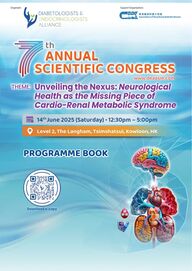
Message PROGRAMME BOOKPROGRAMME BOOKSCIENTIFIC CONGRESSANNUALthANNUALSCIENTIFIC CONGRESSUnveiling the Nexus: Neurological Health as the Missing Piece of Cardio-Renal MetabolicSyndromeTHEME:14th June 2025 (Saturday) • 12:30pm – 5:00pmLevel 2, The Langham, Tsimshatsui, Kowloon, HKwww.deaasm.comwww.deaasm.comDownload e-copySupport Organization:Organizer:
mL/min/1.73m2≥20≥20THE LOWEST THE LOWEST eGFR CUT-OFF FOR INITIATION AMONG THE SGLT2i IN HONG KONG:‡7-928%RRR4HR: 0.72; 95% CI: 0.64-0.82in kidney disease progression or CV deathKidney protection in the broadest CKD population*3-5HFrEF25%RRR121%RRR2in CV death or HHFHR: 0.75; 95% CI: 0.65-0.86HR: 0.79; 95% CI: 0.69-0.90HFpEFCardiac protection in HF across LVEF spectrum1,238%RRR6HR: 0.62; 95% CI: 0.49-0.77in CV deathThe only SGLT2i with CV death reduction in T2DM†6-9* EMPA-KIDNEY study population included patients with CKD who had an eGFR of ≥20 to <45 mL/min/1.73 m2, or who had an eGFR of ≥45 to < 90 mL/min/1.73 m2 with a UACR of ≥200 mg/g. The primary outcome was a composite of progression of kidney disease (end-stage kidney disease, a sustained eGFR decrease to <10 mL/min/1.73 m2, a sustained eGFR decrease of ≥40% from baseline, or death from renal causes) or CV death; 13.1% (432/3,304) in JARDIANCE® group vs 16.9% (558/3,305) in placebo group (hazard ratio 0.72, 95% CI 0.64-0.82, P<0.001). Significant reduction of eGFR decline was observed across all categories of albuminuria.4 DAPA-CKD study population included CKD patients with an eGFR of 25 to 75 mL/min/1.73 m2 and UACR of 200 to 5,000 mg/g.5† The only SGLT2i with CV death reduction in T2DM with eCVD.‡ SGLT2i with indications of T2DM, HF, and CKD in Hong Kong.Abbreviations: CI: Confidence interval; CKD: Chronic kidney disease; CV: Cardiovascular; eCVD=Established cardiovascular disease; eGFR: Estimated glomerular filtration rate; HF: Heart failure; HFpEF: Heart failure with preserved ejection fraction; HFrEF: Heart failure with reduced ejection fraction; HHF: Hospitalisation for heart failure; HR: Hazard ratio; LVEF: Le ventricular ejection fraction; OAD: Oral antidiabetic drug; RRR: Relative risk reduction; T2DM=Type 2 diabetes mellitus; UACR: Urine albumin-to-creatinine ratio.References: 1. Packer M, et al. N Engl J Med 2020;383:1413-1424. 2. Anker SD, et al. N Engl J Med 2021;385:1451-1461. 3. Heerspink HJL, et al. Nephrol Dial Transplant 2020;35:274-282. 4. Herrington WG, et al. N Engl J Med 2023;388:117-127. 5. Heerspink HJL, et al. N Engl J Med 2020;383:1436-1446. 6. Zinman B, et al. N Engl J Med 2015;373:2117-2128. 7. Canagliflozin Hong Kong Prescribing Information. hps://www.mims.com/hongkong/drug/info/invokana?type=full. Accessed on 16 Apr 2025. 8. Dapagliflozin Hong Kong Prescribing Information. hps://www.mims.com/hongkong/drug/info/forxiga?type=full. Accessed on 16 Apr 2025. 9. JARDIANCE® Hong Kong Prescribing Information.Boehringer Ingelheim (HK) Ltd. 1504-9, Great Eagle Centre, 23 Harbour Road, Wanchai, Hong KongTel: (852) 2596 0033 Fax: (852) 2827 0162 www.boehringer-ingelheim.com.hkAbbreviated Prescribing InformationJARDIANCE® (aPI-JARD-05)PC-HK-101576 (May 2025)CMYCMMYCYCMYK
11Table of ContentsWelcome Message 2Scientic Programme 5Floor Plan 6Organizing Committee 7Lunch Symposium: Optimizing CKD Management through Holistic Cardio-Kidney-Metabolic Perspective 8Lecture I:Novel Therapeutics on Painful Diabetic Peripheral Neuropathy – Insights from Anaesthesiologist 10Lecture II:Dementia and Diabetes – Bridging Metabolic Dysregulation and Cerebral Vascular Health 12Lecture III: Incretin-based Therapy and Cognitive Decline in Type 2 Diabetes 14CME Accreditation 28Acknowledgement 29
2Welcome Message2Dear Colleagues, On behalf of the Diabetologists and Endocrinologists Alliance (DEA), I would like to welcome you to join our 7th Annual Scientic Congress.The theme of this year is “Unveiling the Nexus: Neurological Health as the Missing Piece of Cardio-Renal Metabolic Syndrome”. Prof. Jack Kit-Chung Ng, Dr. Timmy Chi-Wing Chan, Dr. Lisa Wing-Chi Au and Prof. Paul Chi-Ho Lee will deliver four lectures concerning CKD, peripheral neuropathy, dementia, and cognitive decline in type 2 diabetes. DEA has been trying to promote and support the study, education and research of diabetes mellitus and endocrinology since 2018. Let us seize this opportunity to learn, connect, and make a lasting impact in the ght against diabetes. Dr. Ka-Kui LEEPresident, Diabetologists and Endocrinologists Alliance
3Welcome Message3Dear Colleagues,Welcome to the 7th Annual Scientic Congress of the Diabetologists & Endocrinologists Alliance (DEA).This year, we are excited to delve into the theme “Unveiling the Nexus: Neurological Health as the Missing Piece of Cardio-Renal Metabolic Syndrome.” This highlights the critical yet underrecognized role of neurological health within the interconnected metabolic, cardiovascular, and renal systems. Our goal is to foster a holistic understanding of these interactions to improve patient outcomes.We are honored to host renowned experts across specialtiesProf. Jack Kit-Chung Ng will present a holistic cardio-kidney-metabolic perspective on optimizing chronic kidney disease (CKD) management, demonstrating how integrated care can address overlapping challenges across these systems.Dr. Timmy Chi-Wing Chan, an expert in anaesthesiology and pain medicine, will share insights into novel therapeutics for painful diabetic peripheral neuropathy, emphasizing the neurological challenges faced by patients with diabetes.Dr. Lisa Wing-Chi Au will delve into the relationship between dementia and diabetes, focusing on the interplay between metabolic dysregulation and cerebral vascular health, and its implications for managing neurological complications.Prof. Paul Chi-Ho Lee will explore the role of incretin-based therapies in addressing cognitive decline in Type 2 diabetes, highlighting how metabolic dysregulation can inuence brain health and cognitive function.These sessions will illuminate neurological health’s pivotal role in cardio-renal metabolic syndrome, empowering healthcare professionals to develop comprehensive strategies for multi-system patient care.We hope this congress serves as a platform for meaningful discussions, knowledge exchange, and collaboration among experts from diverse specialties. Together, let us continue to advance the care of individuals with diabetes and endocrine disorders.Thank you for joining us, and we look forward to an engaging and insightful congress.Warm regards,Dr. Wai-Sheung WONGChairmanOrganizing Committee of the 7th Annual Scientic CongressDiabetologists & Endocrinologists Alliance
55Scientic Programme12:30 Reception12:45 Lunch13:00 – 14:00 Lunch Symposium: Optimizing CKD Management through Holistic Cardio-Kidney-Metabolic Perspective 16:50 – 17:00 ClosingSPEAKER:Prof. Jack Kit-Chung NGAssistant Professor (Clinical), Dept. of Medicine and TherapeuticsFaulty of Medicine, CUHK.......................................................CHAIRMAN:Dr. Wai-Sheung WONGChairman, Organizing Committee, 7th Annual Scientific Congress, Diabetologists & Endocrinologists Alliance16:00 – 16:45 Lecture (III): Incretin-based Therapy and Cognitive Decline in Type 2 DiabetesSPEAKER:Prof. Paul Chi-Ho LEEClinical Associate Professor, Dept. of Medicine, School of Clinical Medicine, LKS Faculty of Medicine, HKU.......................................................CHAIRMAN:Dr. Man-Wo TSANGSpecialist in Endocrinology, Diabetes and Metabolism14:10 – 14:45 Lecture (I): Novel Therapeutics on Painful Diabetic Peripheral Neuropathy – Insights from AnaesthesiologistSPEAKER:Dr. Timmy Chi-Wing CHANConsultant Anaesthetist and Pain Specialist,Dept. of Anaesthesia, Pain and Perioperative MedicineDivision Head of Pain Management Team, Queen Mary Hospital.......................................................CHAIRMAN:Dr. Jonathan Yim-Pui CHUConsultant in Neurology, Gleneagles Hospital Hong Kong14:00 – 14:10 Opening RemarksSPEAKER:Dr. Ka-Kui LEEPresident, Diabetologists & Endocrinologists Alliance15:20 – 16:00 AGM, Break and Physical Booth Exhibition14:45 – 15:20 Lecture (II): Dementia and Diabetes – Bridging Metabolic Dysregulation and Cerebral Vascular HealthSPEAKER:Dr. Lisa Wing-Chi AUClinical Professional Consultant,Associate Professor of Practice in Neurology (by courtesy), Dept. of Medicine and Therapeutics, Faculty of Medicine, CUHK.......................................................CHAIRMAN:Dr. Bosco Hon-Ming MASpecialist in Geriatric Medicine
66Floor PlanLecture RoomBooth ExhibitionCoffee/TeaCoffee/TeaCoffee BreakCoffee Break Coffee BreakRECEPTIONCMENovo NordiskServier Zuellig Abbott BayerAstraZenecaHKEli Lilly NovartisMerck Lee’sRoche OrganonBoehringerIngelheimCoffee/Tea
77Organizing CommitteeDr. Wai-Sheung WONGChairman, Organizing CommitteeDr. Ka-Kui LEEPresident, Diabetologists & Endocrinologists AllianceDr. Susanna Chi-Pun CHANVice President, Diabetologists & Endocrinologists AllianceDr. Cheuk-Lik WONGHonorary Secretary, Diabetologists & Endocrinologists AllianceDr. Winnie Wing-Yan LAU Honorary Treasurer, Diabetologists & Endocrinologists AllianceDr. Patrick Fu-Keung CHEUNGCouncil Member, Diabetologists & Endocrinologists AllianceDr. Peter Chun-Yip TONGCouncil Member, Diabetologists & Endocrinologists AllianceDr. Man-Wo TSANGCouncil Member, Diabetologists & Endocrinologists Alliance
88Lunch SymposiumProf. Jack Kit-Chung NG is the Assistant Professor in the Department of Medicine and Therapeutics, The Chinese University of Hong Kong, and Honorary Associate Consultant in Prince of Wales Hospital. He was a visiting scholar at The George Institute for Global Health (Australia) in 2019.Prof. Ng is the current Council Member and Chairman of the Education Committee of Hong Kong Society of Nephrology (HKSN). He was the core member of Young Nephrologist Committee in both HKSN and Asian Pacic Society of Nephrology (APSN), respectively. He also serves on the International Liaison Committee of International Society for Peritoneal Dialysis (ISPD), and the Renal Registry Steering Group of the Central Renal Committee of Hong Kong. Prof. Ng has received Young Nephrologist Investigator Award from Hong Kong Society of Nephrology and Distinguished Research Paper Award from Hong Kong Society of Physicians. His research interests include cardiovascular disease and volume status in dialysis patients, and the application of novel technologies in monitoring glycemic prole in patients with diabetic kidney disease.Prof. Jack Kit-Chung NG Assistant Professor (Clinical),Dept. of Medicine and TherapeuticsFaulty of Medicine, CUHKBiography
99Lunch SymposiumCardiovascular-kidney-metabolic (CKM) syndrome is a systemic disorder characterized by pathophysiological interactions between metabolic risk factors, chronic kidney disease (CKD), and cardiovascular system, which carries especially profound impact on cardiovascular outcomes. The complex interplay between different systems poses unique challenges in CKM management, which requires an integrated treatment approach. Kidney health is central to CKM syndrome, given the high prevalence of kidney failure among patients with diabetes or cardiovascular diseases. Sodium-glucose cotransporter-2 (SGLT2) inhibitors have demonstrated consistent cardiorenal protection in populations with type 2 diabetes and heart failure. Moreover, recent trials showed that SGLT2 inhibitors signicantly delay the progression of kidney disease in CKD patients irrespective of diabetes status, suggesting their effects have extended beyond glycemic control. Furthermore, emerging evidence suggested that continuation of SGLT2 inhibitors in advanced CKD, in comparison to discontinuation, was associated with lower risk of cardiovascular and kidney events. This lecture will highlight the latest international guideline recommendations, which increasingly prioritize the use of SGLT2 inhibitors for patients in early stage of CKM syndrome. In addition, we will also discuss practical strategies for the implementation of SGLT2 inhibitors in clinical practice, focusing on patient selection, monitoring, and optimizing CKM health of our patients.Optimizing CKD Management Through Holistic Cardio-Kidney-Metabolic Perspective Abstract
1010Lecture (I)Dr. Timmy Chi-Wing CHAN is an Anaesthetic Consultant and Pain Specialist at the Department of Anaesthesia, Pain and Periopertaive Medicine, the Queen Mary Hospital, Hong Kong. He is the Clinical Team Head of Pain Management Team.He is the Fellow of Interventional Pain Practice (FIPP), The World Institute of Pain. He is the winner of the Hassenbusch Prize of FIPP. Dr. Chan is the Chairman of the Multidisciplinary Pain Management Committee in the Hospital Authority. He is the Chairman of the Board of Pain Medicine, The Hong Kong College of Anaesthesiologists.He has wide-ranging interests, including cancer pain management, interventional pain management for non-cancer pain especially neuromodulation, and acute post-operative pain management after major joints arthroplasty. Dr. Timmy Chi-Wing CHAN Consultant Anaesthetist and Pain Specialist,Dept. of Anaesthesia,Pain and Perioperative MedicineDivision Head of Pain Management Team,Queen Mary HospitalBiography
1111Lecture (I)According to the World Health Organization, there are approximately 422 million adults living with diabetes globally, with a prevalence rate of 8.5% that has nearly doubled over the last four decades. This chronic condition poses signicant threats to health, leading to systemic damage that can severely impact the quality of life and, in many cases, can be life-threatening.One of the prevalent complications associated with diabetes is diabetic peripheral neuropathy, which manifests as pain and various sensory disturbances, including numbness, burning sensations, or tingling. It is estimated that around 20% of individuals with diabetes will develop painful diabetic neuropathy (PDN), a progressive and potentially debilitating chronic pain condition.Current treatment options for PDN include several neuropathic pain medications, such as gabapentinoids, serotonin-norepinephrine reuptake inhibitors, tricyclic antidepressants, opioids, and topical solutions. However, high-quality randomized clinical trials have shown that these medications often have limited efcacy and a high incidence of adverse effects. For instance, gabapentinoids can increase the risk of respiratory depression, which poses signicant concerns for patients who are also taking opioids or have pre-existing respiratory issues. In recent years, non-pharmacological treatment options have emerged, such as spinal cord stimulation (SCS), rst reported in 1996. Previous studies have indicated moderate efcacy of low-frequency SCS, but these studies involved smaller sample sizes and shorter follow-up periods. Long-term follow-ups have shown that responder rates tend to decline within the rst year. However, recent observational data suggest that high-frequency SCS, particularly at 10 kHz, offers signicant pain relief for PDN patients without causing the paresthesias typical of other SCS modalities.In this talk, the mechanism of spinal cord stimulation and its application to neuropathic pain conditions, for instance, diabetic peripheral neuropathy will be discussed. Local experiences of SCS in PDN will be shared as well.Novel Therapeutics on Painful Diabetic Peripheral Neuropathy –Insights from AnaesthesiologistAbstract
1212Lecture (II)Dr. Lisa Wing-Chi AU obtained sub-specialty training in cognitive disorder at Baycrest, University of Toronto. Her research focused on utilizing state-of-the-art molecular positron emission tomography (PET) scan and genetic technologies in the study of the mechanisms underlying various cognitive disorders.Dr. AU published the rst cohort of early-onset dementia in Hong Kong. Her study on the mechanism of poststroke dementia obtained the Young Investigator Research Grant of the Hong Kong College of Physicians (2014) and the Best Dissertation Presentation Award of the Hong Kong Neurological Society Annual Scientic Meeting (2012). She was invited to contribute a review article on mixed dementia for the World Alzheimer Report 2021 in the capacity of rst author. She had made 34 publications, six of which were in the capacity of rst author. Two of her rst-author publications were published in the Journal of Neurology with impact factor 8.055. She is the leading clinician overseeing all the research subjects of cognitive disorder and adult neurogenetic studies.Dr. Lisa Wing-Chi AU Clinical Professional Consultant,Associate Professor of Practice in Neurology (by courtesy),Dept. of Medicine and Therapeutics,Faculty of Medicine, CUHKBiography
1313Lecture (II)Both dementia and diabetes are progressive, complex long-term conditions which consume a considerable amount of health and social care resources. As the population gets older, this is likely to become an increasing problem. There is a close association between diabetes and dementia, in particular Alzheimer’s disease and vascular dementia, with diabetes associated with a 60% increase in risk for all-cause dementia. In this lecture, I will outline the proposed mechanisms underlying the association between these two conditions, as well as the clinical implications and future perspectives.Dementia and Diabetes – Bridging Metabolic Dysregulationand Cerebral Vascular HealthAbstract
1414Lecture (III)Prof. Paul LEE graduated in 2006 from the University of Hong Kong (HKU) and became an endocrinologist in 2013. He obtained the Croucher Foundation Fellowship in 2017 and received his Doctor of Medicine degree from HKU in 2022 with the Sir Patrick Manson Gold Medal. He is now a Clinical Associate Professor and the Assistant Dean (Student Wellness and Engagement) of the Faculty of Medicine, HKU.Prof. LEE’s research focuses on type 2 diabetes (T2D) and its complications, particularly in the contribution of adipokines and novel biomarkers that enhance risk stratication in the clinical management of diabetes and its complications. Prof. Lee also has special interests in studying metabolic dysfunction-steatotic liver disease (MASLD) in T2D and initiated the Hong Kong West Diabetes NAFLD Cohort to investigate the risk factors of liver brosis progression in T2D. He is an editorial board member of Journal of Clinical Endocrinology and Metabolism and Diabetes & Metabolism Journal. Over the years, his research has been published in high-impact peer-reviewed journals, and received awards including the Investigator Award by the Asian Association for the Study of Diabetes in 2021, the Faculty Outstanding Research Output Award by HKU, the Young Investigator Outstanding Research Paper Award in 2022, the Richard Yu Lectureship by the Hong Kong College of Physicians (HKCP) in 2023, and the Rosie Young Lectureship by the Department of Medicine of HKU in 2024. He is currently one of the principal investigators of the State Key Laboratory of Pharmaceutical Biotechnology of HKU and the Vice-President of the Hong Kong Society of Endocrinology, Metabolism and Reproduction (HKSEMR). Prof. Paul Chi-Ho LEE Clinical Associate Professor,Dept. of Medicine, School of Clinical Medicine,LKS Faculty of Medicine, HKUBiographyResearch Prole
1515Lecture (III)In an aging and obesogenic population, along with improved overall standards of care and cardiovascular mortality, patients with diabetes are living longer, and cognitive decline becomes an emerging important diabetic complication. Epidemiological studies have found that both diabetes and obesity are important modiable mid-life risk factors of dementia. This talk will provide an updated review of the relationship between type 2 diabetes and dementia, focusing on the use of incretin-based injectables, including the novel glucagon-like peptide 1 (GLP1) and glucose-dependent insulinotropic peptide (GIP) receptor co-agonist, as a promising treatment for patients with diabesity who are also at risk of cognitive decline.Incretin-based Therapy and Cognitive Decline in Type 2 DiabetesAbstract• Assistant Dean (Student Wellness & Engagement), Faculty of Medicine, HKU• Principal Investigator, The State Key Laboratory of Pharmaceutical Biotechnology, HKU • Vice-President, The Hong Kong Society of Endocrinology, Metabolism and Reproduction• Member, Asia-Pacic Diabetes and Obesity (APDO) Study Group • Honorary Secretary and Specialty Programme Director, Specialty Board in Endocrinology, Diabetes and Metabolism of Hong Kong region, Hong Kong College of Physicians • Specialty Member, Expert panel of the subgroup on update on Reference Framework for diabetes care and hypertension care, Food and Health Bureau, HKSAR • Member, Advisory group on Reference Framework for common musculoskeletal problems in primary care setting, Food and Health Bureau, HKSAR Key Ofces
2828CME AccreditationCollege Points Awarded CategoryThe Hong Kong College of Anaesthesiologists 3 PP-NAHong Kong College of Community Medicine 3 PP-PPHong Kong College of Emergency Medicine 2.5 PPThe Hong Kong College of Family Physicians 3 OEA-5.02The Hong Kong College of Obstetricians and Gynaecologists 3 PP-PNCollege of Ophthalmologists of Hong Kong 1 CME-PPThe Hong Kong College of Otorhinolaryngologists Pending PP-2.2Hong Kong College of Paediatricians 3 CAT A-PPThe Hong Kong College of Pathologists 3 PPHong Kong College of Physicians 3 PP-PPThe Hong Kong College of Psychiatrists 2.5 PP-OPHong Kong College of Radiologists 3 B-PPThe College of Surgeons of Hong Kong 3 PPMCHK (The Hong Kong Medical Association) 香港醫學會 3 PASSIVE
2929AcknowledgementGold sponsors:Platinum sponsor:Diamond sponsor:Silver Sponsor:
SCIENTIFIC CONGRESSANNUALthANNUALSCIENTIFIC CONGRESSUnveiling the Nexus: Neurological Health as the Missing Piece of Cardio-Renal MetabolicSyndromeTHEME:www.deaasm.comwww.deaasm.com